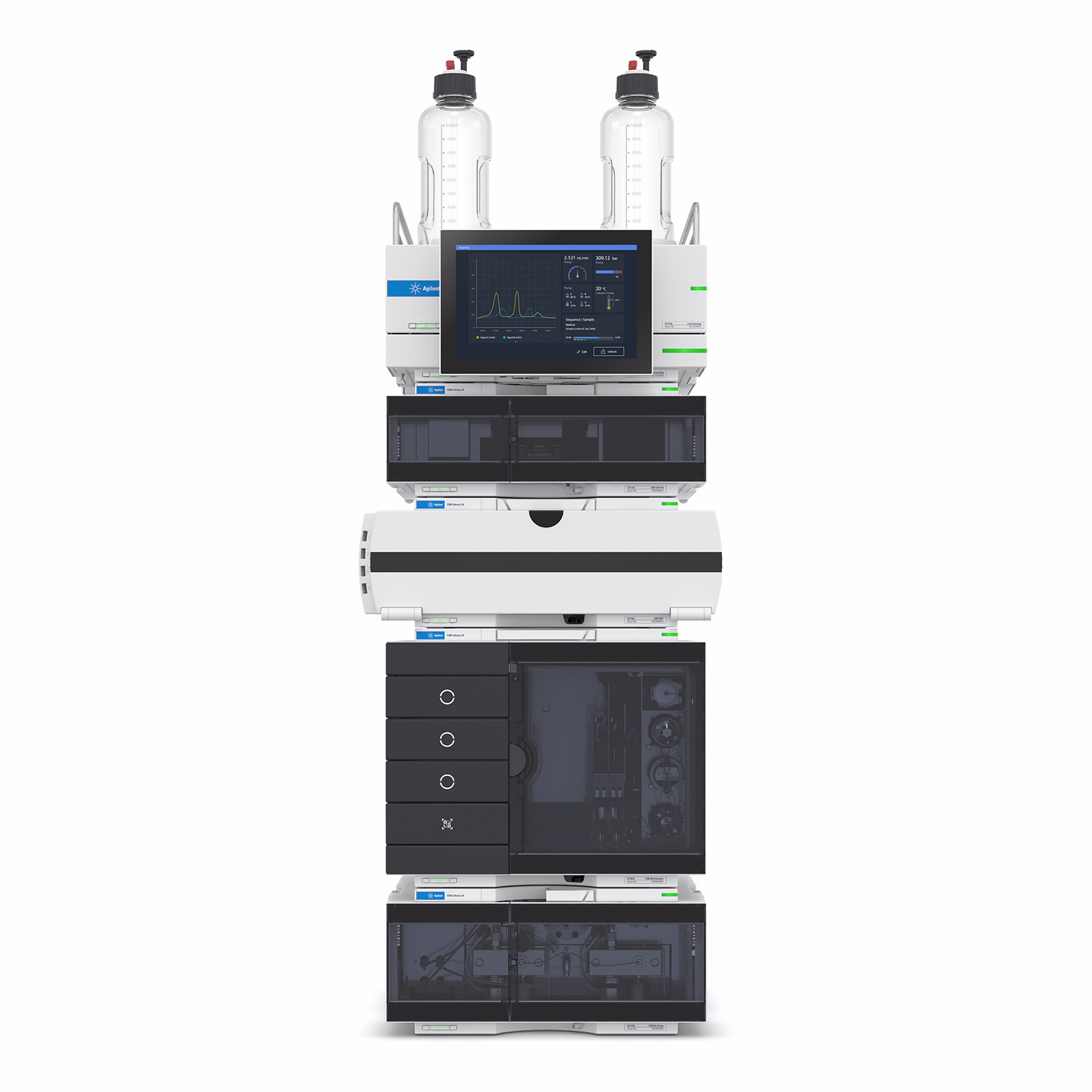
Agilent is one of the world-renowned manufacturers of analytical instruments. Its High-Performance Liquid Chromatography (HPLC) system has been widely used in multiple fields such as chemistry, pharmaceuticals, environmental monitoring, and food safety. High-Performance Liquid Chromatography (HPLC) system, as an important separation and analysis technique, can effectively separate, identify, and quantify the components in complex mixtures. It uses a liquid as the mobile phase and separates the components through a chromatographic column filled with a stationary phase. During the entire process, the sample to be analyzed is injected into the mobile phase. As the mobile phase moves, different components are separated due to their different adsorption capacities on the stationary phase. Finally, the separated components are detected and quantified by a detector.
Separation process of Agilent High-Performance Liquid Chromatography (HPLC) system:
1. Sample injection: The sample to be analyzed is introduced into the mobile phase through an automatic sampler or a manual sampler.
2. Separation process: The sample enters the chromatographic column under the push of the mobile phase. The interaction between the stationary phase and the mobile phase causes different components to be separated according to their different affinities.
3. Detection: The separated components pass through the detector in turn, generating signals and recording data.
4. Data processing: The obtained signals are analyzed through chromatographic software, and finally the concentration and property information of each component in the sample are obtained.
Main components:
1. Pump: It is used to deliver the mobile phase, ensuring a stable flow rate and adjustable pressure. Agilent's pumps feature high precision, high stability, and low noise.
2. Sampler: It is used to accurately inject the sample. Agilent provides both manual and automatic samplers to meet different experimental needs.
3. Chromatographic column: It is the core part. Agilent produces various types of chromatographic columns suitable for different separation needs, such as reverse-phase and normal-phase columns.
4. Detector: It is used to detect the separated components in real-time. Agilent offers a variety of detector options, including ultraviolet detectors (UV), fluorescence detectors (FL), and mass spectrometers (MS).
5. Data processing system: It is equipped with powerful data analysis software that can process and analyze chromatograms and generate reports.
Technical advantages: